How to get a software licence in Dubai 2026: A 12-step roadmap
How to get a software licence in Dubai 2026: A 12-step roadmap
Costs, cyber-risk checks, VARA rules & banking—everything tech founders need to launch in Dubai.
Vincy Amirtharaj
58 post
Senior Business Setup Consultant, Dubai
If you are thinking about how to set up a software company in Dubai in 2025, you are in the right place. The UAE has set a national goal for its digital economy to contribute 20% of the country’s GDP by 2031. This makes Dubai a prime launchpad for SaaS, AI and cybersecurity startups in the Gulf region. This guide explains all the essential details needed to get your software development licence Dubai and the process to start operating without unexpected costs or administrative delays, whether you are an independent developer or a scale-up team relocating from another tech hub.
Dubai’s Department of Economy and Tourism (DET) has taken necessary steps to streamline the entire process. The ‘Invest in Dubai’ portal handles your trade name reservation and digital Memorandum of Association (MoA) from one unified dashboard. Companies will be able to obtain approvals in 5-8 calendar days for free zone entities and less than 2 weeks for mainland LLC after they have prepared all required documents such as passport scans, flexi desk leases (only applicable for free zones) and a business plan. As a result of this streamlined process the cost of obtaining a software licence in Dubai for 2025 has decreased.
Below are the steps to follow when setting up a software business in Dubai including all relevant documentation, fees and compliance. It will help you understand and get through the journey from your first approval through Corporate Tax (9%) registration and banking KYC. Stick to all the 12 steps to avoid the three most common rejection points like incorrect activity code, missing TDRA approval and an incomplete cash-flow forecast. Once you are well-versed with these instructions given throughout, then you can launch your UAE software company on time and within budget.
Typical 4-week software-licence timeline
Week
Authority / Task
Key output
1
DET / Free Zone
Initial approval ✓ | Trade-name cert ✓
2
Land Dept / Ejari
Office lease uploaded
3
TDRA
E-commerce / hosting NOC filed
4
DET / Free Zone
Software licence issued ✓
5
FTA
VAT registration (if turnover ≥ AED 375 k)
6
Bank
Corporate account – Go live!
Note: Fast-track packages at Dubai Internet City or IFZA can
compress Weeks 1-4 to 3-4 days for zero-visa setups.
"Dubai continues to advance as a leader in innovation, developing pioneering solutions that drive its digital transformation journey."
- His Highness Sheikh Hamdan bin Mohammed bin Rashid Al Maktoum
Follow this 12-step checklist to complete your software-licence process in Dubai
Step 1: Confirm your eligible service scope
Match your planned activities to the official licence categories:
This step is important during software company setup in Dubai, as selecting the correct activity scope at the start helps avoid approval delays, rejections or the need for later amendments.
Software development
Custom apps, SaaS products, APIs.
IT consultancy
System integration, project management.
Cyber-security services
Pen-testing, SOC as-a-Service.
Artificial Intelligence Developing Services
Data-science & model-training activities.
E-commerce platform
Marketplace hosting & payment gateways.
Cloud Service & Datacenters Providers
IAAS / PAAS licence under TDRA NOC.
Pro tip
Select only the activity codes you’ll monetise in year 1—adding new codes later is cheaper than removing inactive ones at renewal.
Step 2: Reserve a trade name
Pick a tech-friendly name (avoid “bank”, “insurance”, etc.) and reserve it via DET e-Services or your free-zone portal. Secure the matching domain & branded email—banks dislike generic addresses.
Quick Fact
Since its debut in 2021, the Invest in Dubai platform has enabled the incorporation of 280,916 new businesses.
Source: Invest in Dubai
Step 3: Draft a compliance-ready business plan
A structured business plan is one of the essential steps to start a software business in Dubai, as regulators and banks often review it to assess operational clarity and compliance readiness.
Products & revenue model
SaaS subscriptions, licence fees, support retainers.
IP & data security
Source-code escrow, ISO 27001 roadmap.
Talent & visas
Developer visas, Golden Visa eligibility, remote-first policy.
Pro tip
Add a licence-expiry calendar and IP-protection clause—to help you manage ongoing compliance and growth.
Licence cost snapshot · 2025
DED initial approval: ~AED 120
Trade-name reservation: AED 620
Mainland professional licence fee: AED 9 000 – 14 000
Dubai Internet City FZ-LLC package: from AED 15 200 (0-visa)
Cyber-security liability insurance: from AED 3 800 / year
*No share-capital deposit is required for professional LLCs from 2024 onward.
Licence-cost estimator (AED)
Estimated setup cost: —
Get detailed breakdown on WhatsApp
Includes AED 740 for initial approval (120) + trade-name reservation (620).
Office rent, insurance & visa deposits vary—contact us for an exact quote.
Step 4: Select the right business structure
Your legal form influences which authority issues the licence, visa quotas, and banking credibility:
When you set up your business in Dubai, choosing the correct structure at this stage helps ensure regulatory alignment.
LLC (Mainland)
Ideal for on-shore software development and IT consulting under the DED “Computer Systems & Communication Equipment Software Design” licence.
Sole establishment
Great for solo freelancers—lower fees but personal liability; upgrade later to LLC when you add partners.
Free-zone FZ-LLC / FZE
100 % foreign ownership; licence issued by the zone, may need a TDRA NOC if the activity qualifies as regulated e-activity.
Branch office
Let an overseas SaaS parent operate under its balance sheet—often shortens bank KYC.
Pro tip
No minimum share capital is required for professional LLCs, but banks still ask for a capital-injection statement—budget at least AED 50 k in the first-year cash-flow file.
Planning your software licence in Dubai?
If you want structured support beyond the licence, Retyn helps founders set up the entire operational layer—from IP protection and cloud readiness to developer visas and compliance.
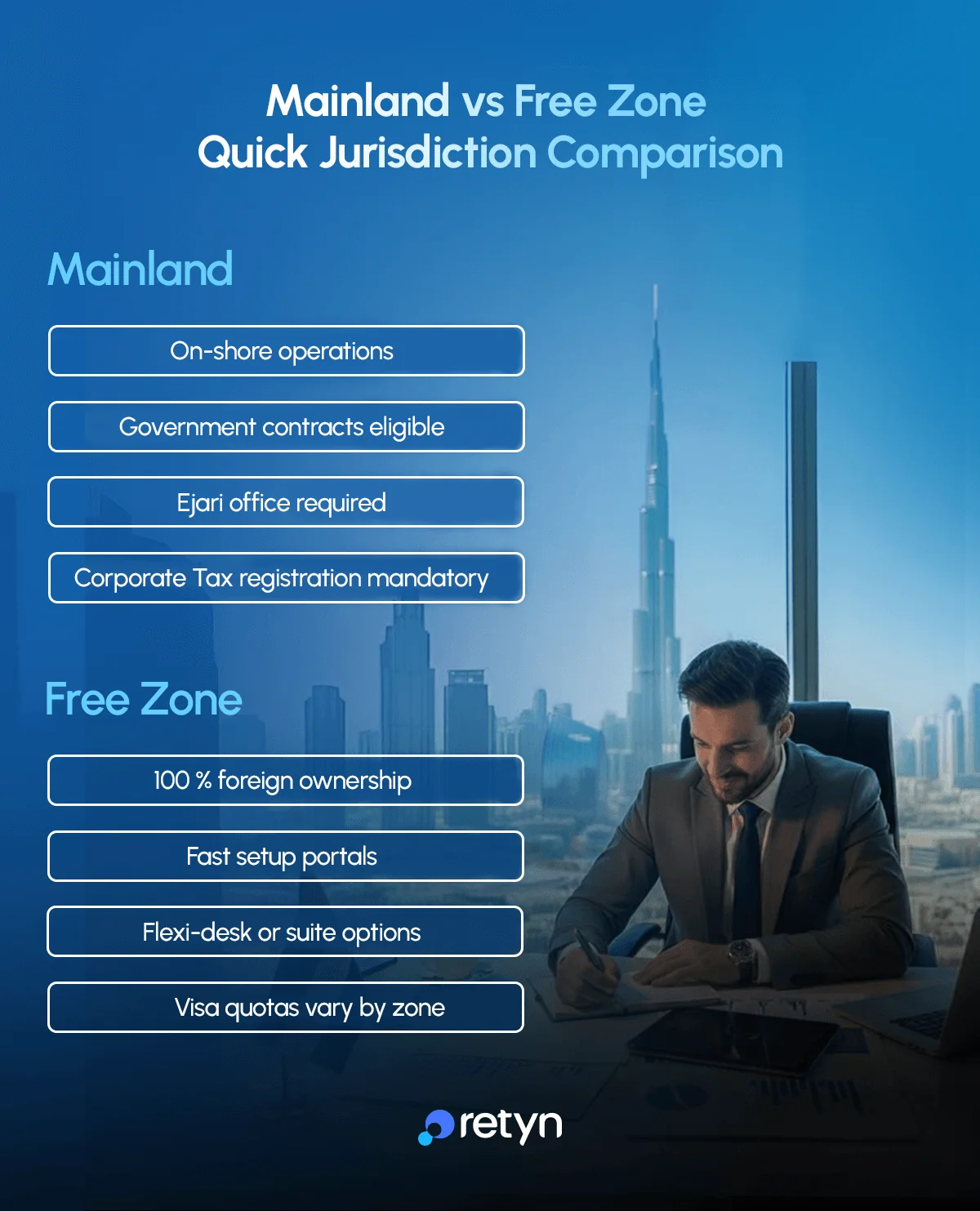
Where you register dictates regulations, visa quotas, and tax exposure.
Mainland
Operate on-shore, pitch government tech tenders, and issue unlimited invoices inside the UAE. In a typical mainland company setup in Dubai, the business must obtain a DET professional licence, Ejari office lease, and Corporate-Tax registration.
Key requirements:
Ejari tenancy
Physical or co-working office recorded with DLD.
TDRA e-commerce NOC
Needed if you wish to engage in an activity of an economic nature.
Corporate Tax registration
9 % CT within 3 months of licence issuance.
Free zones
100 % foreign ownership, fast digital setup, and sector-specific clusters such as Dubai Internet City (DIC) or Dubai Silicon Oasis (DSO).
When planning a free zone company setup in Dubai, businesses should review the activity scope and operating limitations defined by the chosen free-zone authority.
Ideal for:
Dubai Internet City (DIC)
Enterprise SaaS and AI research labs.
Dubai Silicon Oasis (DSO)
R&D hardware–software integration.
IFZA / Meydan
Bootstrapped consultancies & e-commerce.
Quick Fact
The software market in the UAE is expected to reach a projected revenue of US$ 11,374.1 million by 2030
Source: Grand View Research
Step 6: Apply and obtain your software licence
Submit online applications and required documents to the relevant licensing authority. Additional regulatory approvals apply only for specific activities.
Mainland
DED professional licence
Select the appropriate DET-approved activity code from the official activity list.
Professional indemnity insurance (optional)
Cover code defects & cyber incidents (AED 1 m+).
TDRA NOC
Required for hosting, VOIP, or marketplace models.
Free zone
Online application
DIC, DSO, IFZA portals—2-7 days.
Legal form
FZ-LLC (multi-shareholder) or FZE (single owner).
Activity codes
Select exact activity names from the relevant Free Zone’s approved activity list.
Office lease
Flexi-desk or private suite; visas issued once lease is active.
VAT registration
Submit TRN application if revenue ≥ threshold.
Licence-application document checklist
Mainland LLC / Sole Establishment
Passport & UAE entry stamp (all shareholders)
Emirates ID or UID number
Office lease / Ejari certificate
TDRA e-commerce NOC (if applicable)
Business plan & 12-month cash-flow
No-objection certificate (if on existing visa)
Initial approval & trade-name certificates
Free zone (e.g., DIC)
Passport copy (all shareholders)
Last entry stamp or e-visa copy
Shareholder CV + photo
Flexi-desk or office lease agreement
Activity-code selection form
TRN/VAT registration (post-licence)
Proof of address (utility bill or bank statement)
Tip: Combine PDFs ≤ 10 MB each to avoid portal rejections. Keep originals for bank KYC.
Create your establishment card in the GDRFA portal, register for WPS payroll, and issue investor visas.
Developers earning ≥ AED 30 000 / month may qualify for the
10-year Golden Visa. Remote-first teams can sponsor staff under the “Virtual Work” visa if employees remain abroad. The UAE offers a long-term Golden Residence Permit (up to 10 years) for entrepreneurs with innovative, technology-oriented businesses or projects.
To qualify for a golden residence permit, the entrepreneur must have a pioneering project registered with the Ministry of Economy or relevant local authorities, with an annual income of AED 1 million.
Source – GDRFA
Turn information into an actionable setup plan
Use our free business consultation to map your software licence, IP protection, and visa requirements based on your business model.
Provide your new licence, office lease, projected cash-flow, and
AML policy. A live website with @company.com email accelerates KYC.
Prefer banks experienced with SaaS recurring-revenue models (e.g., Mashreq
NeoBiz, Wio, Emirates NBD Business).
Tip: Including a brief product demo video link
often shortens compliance reviews for SaaS firms.
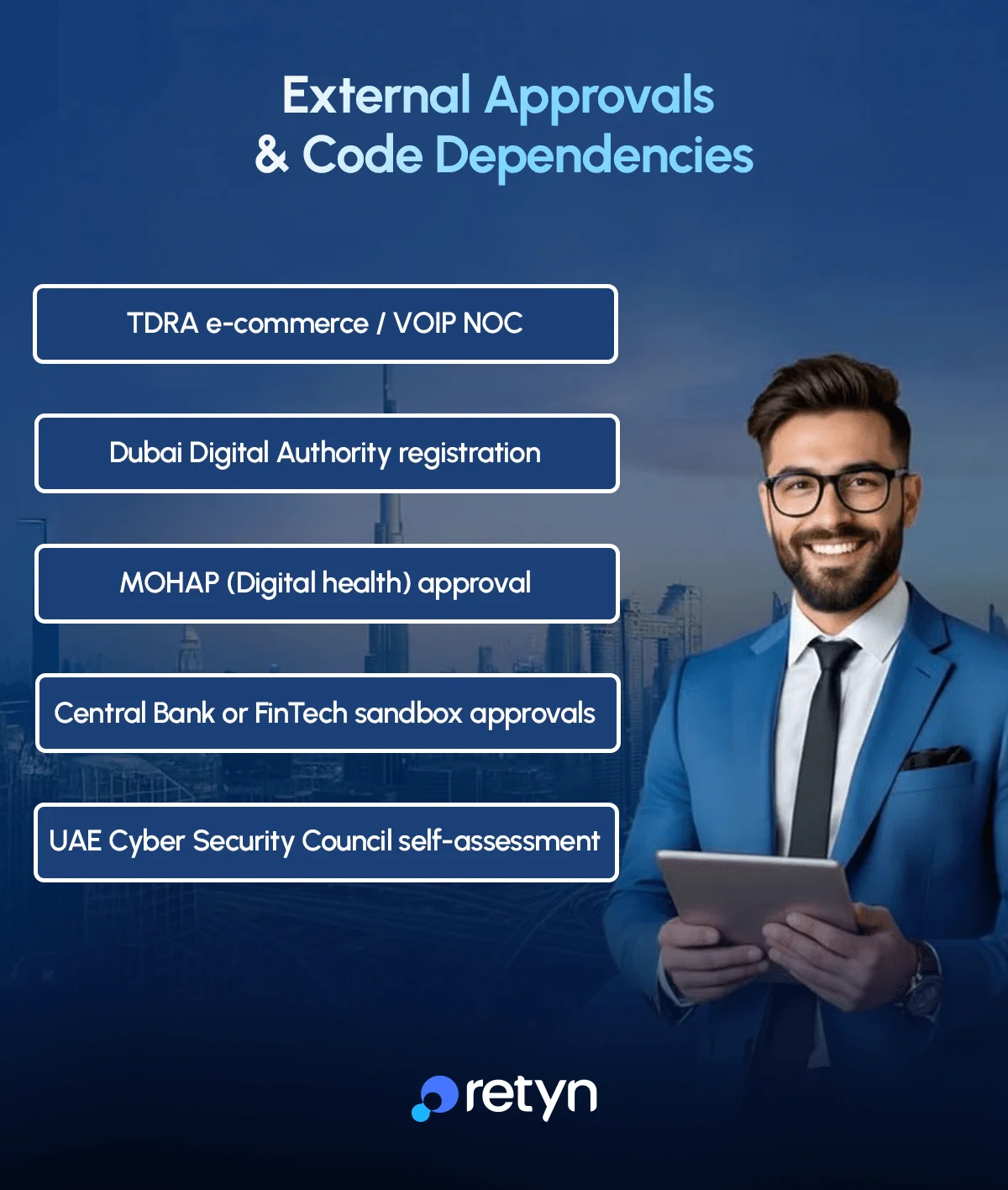
Step 9: Secure external approvals & industry codes
Beyond DET / free-zone, you may need:
This step often surprises first-time founders and is an important consideration in the steps to start a business in Dubai for compliance-sensitive industries.
TDRA e-commerce / VOIP NOC
A TDRA e-activity NOC is required if your business conducts regulated economic activity online. Software offering VOIP services may require additional TDRA telecom approvals.
Dubai Digital Authority registration
Required for integration with Dubai government/data platforms.
UAE Cyber Security Council self-assessment
Follow the cybersecurity frameworks, policies and best-practice guidance issued by the UAE Cyber Security Council.
Publishing digital-health or fintech software? Obtain additional approvals from MOHAP or
Central Bank sandboxes before launch.
Maintain professional-indemnity (errors & omissions) insurance, cyber-liability cover, and staff medical insurance.
File voluntary copyright registration with Ministry of Economy to record source-code ownership—no bank guarantee is required for software licences.
Step 11: Stay compliant — renewals & taxes
Schedule these annual tasks to keep your licence active and avoid fines:
Licence renewal
DET / free-zone fee & paperwork every 12 months.
Insurance renewal
PI & cyber-liability cover.
Corporate Tax & ESR
9 % CT return, Economic-Substance Report.
VAT returns
Quarterly if turnover ≥ AED 375 k.
ISO audits
ISO 27001 / 27701 surveillance visits.
Pro tip
Set calendar alerts 30 days before licence and insurance expiry—banks freeze accounts if documents lapse.
Step 12: Obtain sector-specific clearances
If your software falls under regulated verticals, secure extra approvals:
FinTech Sandbox (DFSA / CB-UAE)
P2P lending, crypto-exchange or robo-advisory pilots.
Digital-health (MOHAP)
Tele-med & medical-record hosting.
EduTech (KHDA)
Paid e-learning platforms targeting UAE students.
Generative-AI code of conduct
Self-assessment plus bias-testing log (voluntary 2025).
Pro tip
Sandboxes and economic programmes sometimes offer application fee relief or tailored incentives. Check the specific sandbox or free-zone offer.
Expert insight: Five macro forces reshaping Dubai’s software scene
1. Sovereign-cloud rules boost local hosting demand.
Data centers operated by the U.A.E. government are increasingly being used as the backbone to support its national digital infrastructure policy. This includes enhancing data sovereignty, improving security through cybercrime protection and ensuring regulatory compliance. After hosting sensitive information in U.A.E.-based data centers, government and corporate organizations will be able to create a trust-based environment to develop and utilize secure digital services and advanced analytical tools.
The major players in the ecosystem such as du's National Hypercloud (an Oracle partnership), Microsoft-backed cloud systems via G42 and U.A.E.-based providers such as Khazana Data Centres are creating sovereign cloud and hyperscale zones. This will allow them to engage globally while also meeting their respective data governance needs domestically.
2. Generative-AI compliance is about to separate pilots production.
With generative AI evolving from being an experimental technology into becoming a critical operational component of businesses within the UAE, many enterprise organizations across the Gulf Cooperation Council (GCC) are rapidly becoming global leaders in AI adoption. IDC predicts that spending on AI in the META region will grow to $14.6 billion by 2028. The sheer scale of these massive deployments has created an immediate need for regulatory certainty.
This trend creates a huge opportunity gap. Companies focused solely on building AI functionality will remain stuck in development limbo, while companies that create their offerings based upon trust and compliance will get into the biggest enterprise deals.
3. Tax and funding incentives are tilting strongly toward deep tech and export SaaS.
The UAE has made it clear that it intends to promote innovation driven companies through targeted tax and incentive measures that support R&D, IP based initiatives and internationalization. For instance, preferential tax rates as well as other incentives are available to qualifying innovation firms and free zone entities.
The Central Banks Open Finance initiative (Phase-2) is providing standardized AIS and PIS API's along with a centralized trust framework and a certification pathway for licenced fintechs. This is creating a clear, regulated rails for fintech builders and cross-border subscription or payment product developers within the UAE. Fintechs that meet the frameworks compliance, security and certification requirements will be able to connect with banks and expand their business faster.
Pro tip
Add a one-pager on sovereign-cloud readiness and AI copilot roadmap to your investor deck—VCs now prioritise both.
Risk & penalty matrix – key non-compliance fines
Offence
Fine (AED)
Operating on an expired licence
5,000.00
Failure to comply with permit terms
3,000.00
Failure to remedy a violation within the time frame prescribed by the DED
5,000.00
Figures from DET. Check latest circulars before budgeting.
Selecting an activity code that mis-matches services—TDRA will reject VOIP apps without the right code.
Opening a bank account before final licence—banks need the licence first.
Using a PO-box only—DED and banks require a physical address.
Regulation & News updates - 2025
VARA issues circular clarifying mandatory AML/CFT risk assessments - 7 Nov 2025:
Mandatory compliance update requires firms to strengthen, document and conduct quarterly AML risk assessments or face enforcement action.
UAE issues new AML law for virtual asset companies - 24 Nov 2025:
Virtual asset companies are brought under stricter federal supervision, requiring immediate compliance assessments and remediation solutions.
Dubai launches new AI projects to accelerate digital transformation - 19 Oct 2025:
New AI and startup programmes launched to speed up digital transformation and strengthen UAE's position as a global hub for future technologies.
UAE issues new rules for geospatial data and mapping activities - 9 Oct 2025:
The regulation sets mandatory licensing, permit controls and security standards for all geospatial, mapping and surveying activities in the country.
Dubai Founders HQ launched to boost digital entrepreneurship - 6 Oct 2025:
The new platform brings together founders, investors, corporates and government entities to support startups through acceleration programmes.
UAE launches new AI Specialists Visa to attract global tech talent - 29 Sep 2025:
The AI specialist visa permits single or multiple entries for a set period and requires an official invitation from sponsoring UAE tech company.
Glossary of acronyms
TDRA – Telecommunications & Digital Government Regulatory Authority
PDPL – Personal Data Protection Law
CT – Corporate Tax (9 %)
ESR – Economic Substance Regulations
PI – Professional Indemnity insurance
MRR – Monthly Recurring Revenue
FAQs on securing a software licence in Dubai
The usual processing time for Mainland LLCs after you have uploaded your documentation is 10 to 14 days. However, if you choose one of the "express" options offered through Dubai Internet City, IFZA or Meydan, which include zero-visa company setups the process can be completed in just 3 to 5 business days.
No. All software development, SaaS, IT consulting and ecommerce companies may be 100% foreign owned in both free zones and mainland areas. A UAE service agent is required only for a branch of a foreign company and not for an LLC or FZ-LLC.
Professional Indemnity (errors and omissions), the type of insurance that will provide protection against errors in code and delayed projects.
Cyber liability will protect your business from being held liable if you experience a data breach or ransomware attack.
Staff medical insurance is also a requirement as per the DHA regulations.
You can find entry level PI plus cyber policy for approximately AED 3,800 per year with an AED 1 million limit.
You will need a TDRA Notice of Compliance if you:
Have your customer's data and have a SaaS subscription-based service.
Offer VOIP, messaging or fintech API's.
Run a marketplace where payments are settled within the UAE.
Consulting or on-premise development services do not require the NOC.
When an individual opens an account with a bank, they usually are asked to provide some of the following:
A copy of the final trade licence and MOA.
A copy of your Ejari, office lease or flexi-desk contract.
Proof of a minimum 12-month cash flow forecast along with at least two client LOI as proof of business income.
A screenshot of your company website. Email proof of your business is required (@company.com).
Passport and Emirates IDs documents are required by all shareholders.
Including a short demo video in your application can assist in shortening the bank review of your application.
Value-Added Tax (VAT) registration is mandatory if your UAE taxable turnover exceeds AED 375,000 in any twelve month rolling period. Export SaaS invoice sales are exempt from VAT.
Corporate Tax (CT), which is 9% of net profits above AED 375,000. Research & Development (R&D) expenditures qualify as super-deductions of eligible business expenses, that is up to 150% of such expenditures.
The estimated yearly renewal costs for a mainland LLC are between AED 5,000 to 9,000 (plus Ejari renewal). And the DIC/IFZA/Meydan free zone has an estimated yearly renewal cost of AED 9,000 to 12,000 (including the flexi-desk option).
Each year you must renew your trade licence, PI insurance and cyber insurance. In addition, you must file your VAT and Corporate Tax returns on a quarterly or annual basis and submit your Economic Substance Report within 12 months of your fiscal year-end.
Disclaimer: This content is for information only and not legal advice. Regulations change—always consult a qualified professional.
Need help getting your software licence approved?
Book a free consultation with our team for step-by-step guidance.